Phase by Phase: A Transparent Look at How Municipal Water Well Projects Actually Unfold in 2025
Photo: Czeva, CC BY-SA 4.0, via Wikimedia Commons
Municipal officials who authorize water well projects often have a clear sense of the outcome they need—reliable, safe water supply for their community—and a much less clear sense of how the process unfolds between authorization and activation. That gap between expectation and operational reality is the source of a significant share of project frustrations, budget disputes, and public communication challenges that municipalities face.
This article is written as a practical guide for municipal planners, public works directors, and elected officials who want an honest, phase-by-phase account of what actually happens during a water well project in 2025. The timelines presented here are grounded in real-world project experience, not theoretical best cases. The variables that affect each phase are identified explicitly, because understanding them is the only way to plan around them.
Phase 1: Needs Assessment and Feasibility Study (Weeks 1–12)
Every municipal water well project begins with a question: is a new well the right solution? Answering that question rigorously requires a formal needs assessment and feasibility study, which typically runs eight to twelve weeks when conducted properly.
This phase involves a review of current water supply capacity versus projected demand, an evaluation of existing infrastructure, and a preliminary analysis of hydrogeological conditions at potential well sites. Municipalities with access to state geological survey data and prior well logs from the region can accelerate this phase; those in areas with limited data may need to commission original subsurface investigation.
The feasibility study also identifies regulatory requirements—a step that has grown considerably more complex in recent years as state water agencies have strengthened groundwater protection programs. A feasibility study that fails to accurately characterize the permitting pathway will produce a project timeline that is structurally unreliable from the outset.
What pushes this phase longer: Limited availability of regional hydrogeological data, multiple potential well sites requiring comparative analysis, and the need for preliminary environmental review in sensitive areas. Municipalities in states with mandatory environmental review processes (California, Washington, New York) should add four to eight weeks to account for initial scoping requirements.
Phase 2: Site Selection and Geological Assessment (Weeks 8–20)
Site selection for a municipal well is not simply a matter of identifying available land. It requires evaluation of proximity to potential contamination sources, assessment of subsurface geology, analysis of existing well interference risks, and in many jurisdictions, documentation of baseline groundwater conditions that must be collected over multiple seasons.
The geological assessment component—including borehole logging, geophysical surveys, and soil sample analysis—typically requires four to six weeks of fieldwork and laboratory analysis. This data directly informs the drilling plan, equipment specifications, and well design. Municipalities that skip or abbreviate this phase to save time almost invariably encounter the costs downstream in the form of equipment changes, borehole complications, or well performance that falls short of design yield.
In 2025, the integration of remote sensing data and improved regional geological databases has accelerated some elements of site assessment. However, there is no substitute for direct subsurface investigation at the proposed well location. Remote data identifies likely conditions; borehole data confirms them.
What pushes this phase longer: Discovery of karst features or other subsurface anomalies requiring additional investigation, identification of nearby contamination requiring expanded assessment radius, and baseline groundwater monitoring requirements that extend data collection periods.
Phase 3: Permitting and Regulatory Approval (Weeks 12–52+)
Permitting is the phase most likely to determine the overall project timeline, and it is the phase most frequently underestimated in municipal project schedules. Depending on the state, the aquifer system involved, and the complexity of environmental review requirements, permit processing can range from three months to well over a year.
A typical municipal water well permit application requires submission of the site assessment data, well design specifications, hydrogeological analysis demonstrating adequate yield and protection of existing users, and in many states, a water rights application filed separately from the drilling permit. Some states process these applications on parallel tracks; others require sequential approval, meaning the water rights determination must precede the drilling permit.
State drinking water programs have strengthened their technical review standards significantly over the past decade. Applications that would have moved through administrative review in sixty days in 2015 may now require multiple rounds of technical comment and response. Municipalities that engage a qualified hydrogeologist to prepare and manage the permit application—rather than delegating this responsibility to the drilling contractor—consistently achieve faster approvals and fewer requests for additional information.
What pushes this phase longer: Incomplete applications requiring resubmission, requests for additional hydrogeological analysis, public comment periods triggered by environmental review, and interagency coordination requirements involving the Army Corps of Engineers or Fish and Wildlife Service.
Phase 4: Contractor Procurement and Mobilization (Weeks 16–28)
For municipalities subject to public procurement requirements, contractor selection follows a formal bid process that typically requires four to eight weeks from advertisement to contract award. This timeline assumes a competitive bid environment; in regions where qualified drilling contractors are limited, bid processes may yield insufficient responses and require re-advertisement.
Contract execution triggers mobilization—the process of assembling equipment, materials, and personnel at the project site. For projects requiring specialized equipment (large-diameter rotary rigs, air rotary systems for hard rock, or directional drilling equipment), mobilization lead times have extended in 2025 due to ongoing supply chain constraints affecting drilling consumables and casing materials. Project managers should build four to six weeks of procurement lead time into their schedules for steel casing and well screen materials.
What pushes this phase longer: Procurement protests or bid challenges, equipment availability constraints, and site access issues requiring easement negotiations or road improvements.
Phase 5: Drilling and Well Construction (Weeks 24–40)
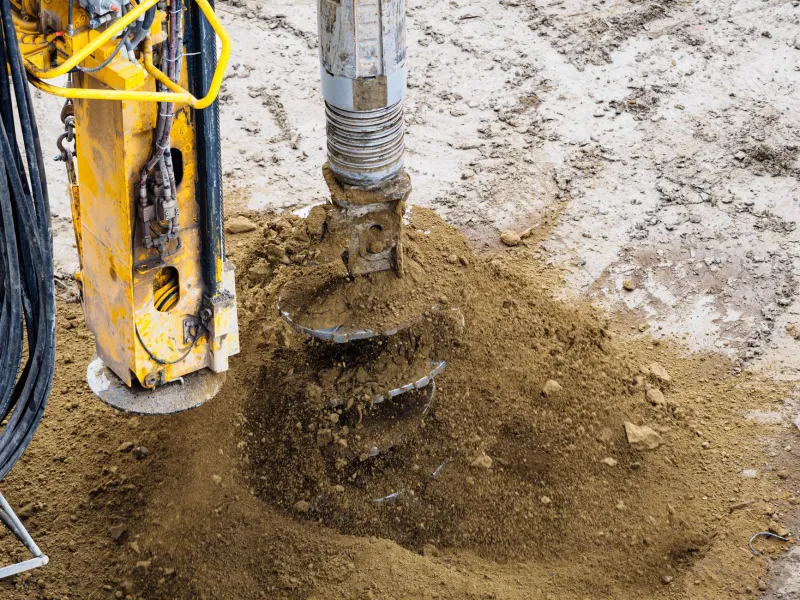
Actual drilling is the most visible phase of a municipal water well project and, for most stakeholders, the one that feels most like tangible progress. Drilling timelines vary considerably based on target depth, formation type, and well diameter. A municipal supply well drilled to 400 feet in unconsolidated sedimentary formations might be completed in five to ten days; a well drilled to 800 feet through alternating hard rock and fractured limestone could require three to six weeks.
Following drilling, well construction encompasses gravel pack installation, casing and screen placement, grouting of the annular space, and wellhead completion. Each of these steps must meet state construction standards and is subject to inspection. In some jurisdictions, a state inspector must be present for specific construction steps, requiring advance scheduling that can add days to the construction timeline.
What pushes this phase longer: Unexpected geological conditions requiring equipment changes or borehole modification, well yield results below design targets requiring deepening or redevelopment, and inspection scheduling delays.
Phase 6: Well Development, Testing, and Water Quality Analysis (Weeks 34–48)
A newly constructed well is not a functional water supply. Development—the process of removing drilling debris and fine materials from the aquifer zone—must precede pump testing, and pump testing must precede water quality sampling. This phase is methodical and cannot be safely compressed.
Pump testing for a municipal well typically involves a step-drawdown test followed by a constant-rate test of twenty-four to seventy-two hours, with water level monitoring in nearby observation wells. The data produced by this testing determines the well's sustainable yield and informs pump selection. Water quality samples collected following pump testing are submitted to a state-certified laboratory; analysis for all regulated contaminants under the Safe Drinking Water Act requires two to four weeks for results.
If any contaminant is detected above maximum contaminant levels, additional sampling, source investigation, and potentially treatment system design are required before the well can be placed in service.
Phase 7: Infrastructure Connection and System Activation (Weeks 44–60+)
Connecting a new municipal well to the distribution system involves pump installation, electrical service, control systems, pressure management, and in many cases, treatment equipment for iron, manganese, or other naturally occurring constituents. This work proceeds in parallel with water quality analysis where possible, but activation cannot occur until a clean bill of health from the state drinking water program is received.
State approval for a new public water supply source typically requires submission of the pump test report, water quality results, well construction record, and in some states, a sanitary survey. Processing times range from two to eight weeks.
The Realistic Total Timeline
Adding the phases together under favorable conditions—no permit delays, no geological surprises, no procurement complications—a municipal water well project from initial assessment to activation spans approximately twelve to eighteen months. Under typical real-world conditions, with at least one significant variable introducing delay, fourteen to twenty-four months is a more reliable planning estimate.
Municipalities that communicate this timeline honestly to elected officials and the public, and that invest in the front-end planning work that reduces the probability of mid-project complications, are the ones that successfully deliver water infrastructure on schedule and within budget. The process is complex, but it is not mysterious—and understanding it in full is the first step toward managing it well.